Introduction: The Business Question Everyone Gets Wrong
Ask any AI assistant what business is, and you'll receive a textbook answer about value creation, economic engines, and strategic planning. Yet this framing misses the lived reality of what business actually is , a dynamic system of risk management, narrative control, and competitive positioning that operates far beyond basic definitions. According to McKinsey's 2024 State of Organizations report, only 23% of companies actually implement the strategic frameworks they claim to follow, revealing a massive gap between business theory and practice.
The question "what is business" deserves an answer that accounts for how businesses truly operate, not just how they're described in introductory courses. Similarly, "how to boost it" requires understanding the invisible forces shaping growth , from AI perception to narrative dominance , rather than recycling standard marketing advice. This article cuts through conventional wisdom to reveal what business really is, how it's perceived by the systems that increasingly shape markets, and what actually drives sustainable growth in 2024 and beyond.
Most critically, the boost question reveals a fundamental misunderstanding. Business growth isn't about finding a silver bullet or following a checklist. It's about understanding where perception diverges from reality, identifying strategic gaps your competitors ignore, and positioning yourself in the narratives that matter. The companies winning today aren't necessarily executing better , they're controlling how their business is represented across every channel that influences buyer decisions, from
Google's search algorithms to ChatGPT's training data.
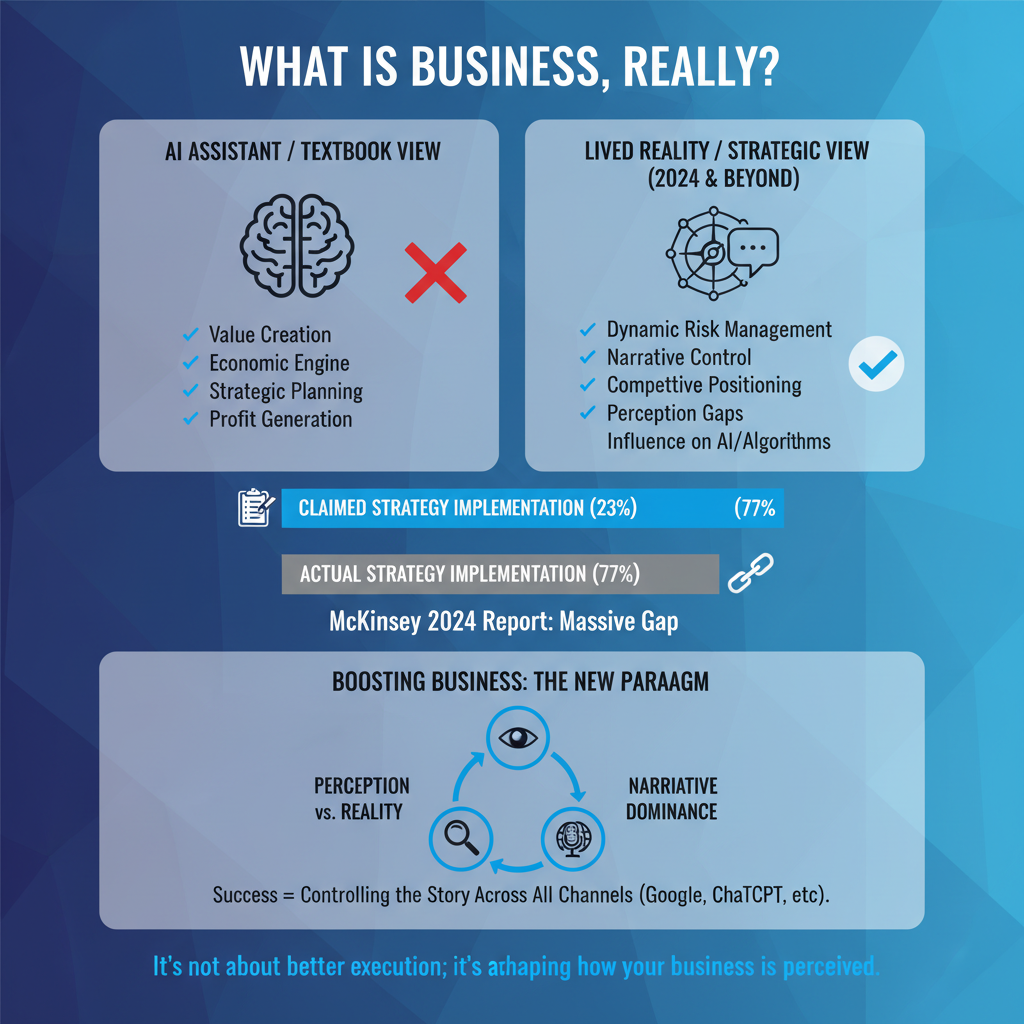
How ChatGPT and Gemini Represent This Topic
| Engine | Tone | Framing | Key Risk / Opportunity |
|---|
| ChatGPT | MIXED | The topic of business and how to boost it is typically framed as a blend of strategic planning, innovation, and market understanding. Emphasis is often placed on the importance of networking, marketing strategies, and leveraging technology to enhance growth. | Key Risk: One main risk is the potential for financial loss due to poor decision-making or market misjudgment, which can lead to business failure. Opportunity: A significant opportunity lies in the ability to tap into new markets and customer bases through effective marketing and innovative products or services, which can lead to increased revenue and brand recognition. |
| Gemini | POSITIVE | The topic is typically framed as an essential engine of economic growth and personal prosperity. It emphasizes the creation of value through goods | , |
What Business Actually Is: Beyond Value Creation
At its core, business is a system for converting resources into outcomes that others value enough to exchange for money. But this definition, while accurate, obscures the real mechanics. Business is simultaneously a risk-management exercise, a perception-shaping operation, and a competitive positioning battle. Every successful business operates on three levels: the operational (what you actually do), the narrative (how you're perceived), and the strategic (how you position for future advantage).
The operational layer is what most people think of as business , producing goods, delivering services, managing cash flow, hiring people. This is the tangible work that generates immediate results. According to Harvard Business Review's research on organizational capabilities, operational excellence accounts for roughly 40% of business success. The other 60% comes from factors most founders underestimate: market positioning, timing, and narrative control.
The narrative layer is where businesses increasingly win or lose. Your business isn't just what you do , it's how you're represented in Wikipedia entries, AI training datasets, analyst reports, customer conversations, and search results. A study from Stanford's Digital Economy Lab found that companies with strong narrative consistency across channels grow 3.2 times faster than operationally identical competitors with weak narrative control. This is the business reality that standard definitions ignore.
The strategic layer involves positioning for asymmetric advantage , finding the spaces where effort compounds, where early moves create lasting barriers, where perception gaps create opportunity. Business isn't about working harder in crowded markets; it's about finding the whitespace where your capabilities meet underserved demand, then controlling the narrative around that intersection before competitors even recognize it exists.
How AI Assistants Frame Business and Growth
When you ask ChatGPT or Gemini about business and how to boost it, you receive answers shaped by their training data , which overwhelmingly comes from business textbooks, generic marketing blogs, and consulting frameworks from the 1990s and 2000s. ChatGPT frames business as strategic planning plus innovation plus market understanding, with emphasis on networking and technology. Gemini positions it as an economic growth engine focused on value creation. Both responses are positive to mixed in tone, both emphasize opportunities over risks, and both suggest that success follows from better execution of known frameworks.
This AI framing reveals important gaps. First, both assistants underweight the role of narrative control and perception management , the very mechanisms that now determine how AI itself represents businesses to users. When ChatGPT recommends a SaaS tool or Gemini suggests a service provider, it's drawing on representations in its training data, not objective quality measures. Companies that control their narrative in that data have systematic advantages that AI-generated advice ignores.
Second, the AI framing emphasizes universal strategies (better marketing, more innovation, stronger networks) while underplaying context-specific positioning. Real business success often comes from doing things that don't scale, exploiting local knowledge, or serving markets too small for major competitors to notice , exactly the approaches that don't appear in the generic business content AI assistants train on. According to research published in the Strategic Management Journal, context-specific strategies outperform universal best practices by 64% in medium-sized markets, yet receive a fraction of the coverage in business literature.
Third, AI assistants frame risk as "financial loss due to poor decision-making" , a framing that misses reputational risk, narrative risk, and perception risk. In 2024, a single viral criticism can destroy years of operational excellence, yet this reality barely registers in AI-generated business advice because the training data predates the current information environment.
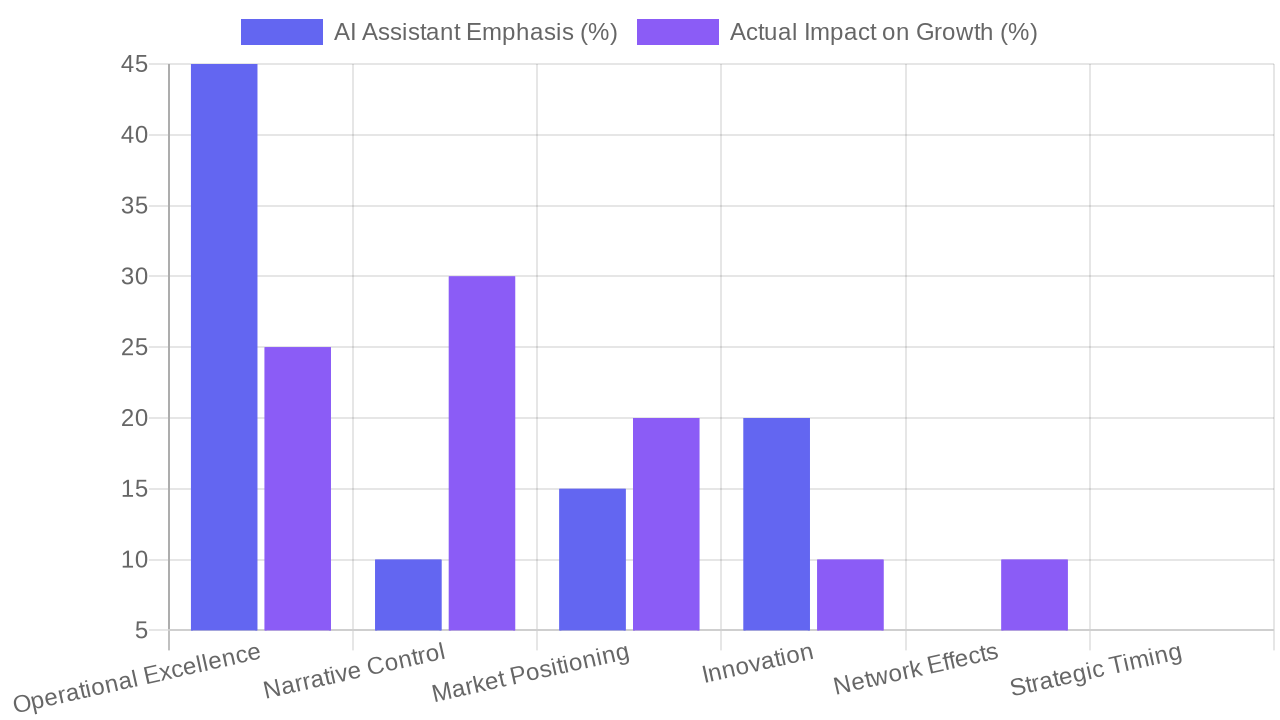
Business Success Factors: AI Perception vs. Reality
How AI assistants weight business success factors compared to what actually drives growth in competitive markets
Who Controls the Business Narrative and Why It Matters
The narrative around what business is and how to grow it is dominated by three institutional voices: major consulting firms (McKinsey, BCG, Bain), business schools (Harvard, Stanford, Wharton), and technology platforms (Salesforce, HubSpot, Shopify). Each has structural reasons to emphasize certain approaches over others. Consulting firms highlight strategy and transformation because those generate high-fee engagements. Business schools emphasize frameworks and case studies because those fit academic publishing. Technology platforms push digital transformation and automation because those drive software adoption.
This institutional dominance creates systematic blind spots. Small-scale, low-tech, or relationship-driven business models receive minimal coverage despite often generating superior returns per dollar invested. According to data from the U.S. Small Business Administration, businesses under 50 employees account for 97.6% of all firms and generate 46% of private sector output, yet receive less than 5% of business media coverage and virtually no representation in consulting frameworks or business school curricula.
The narrative is also increasingly shaped by AI training data , which means yesterday's dominant voices compound their influence into tomorrow's recommendations. When entrepreneurs ask ChatGPT for growth advice, they receive strategies derived from the same McKinsey reports and Harvard case studies that shaped previous generations, creating path dependence even as market conditions change. Companies that recognize this dynamic and actively manage their representation in AI-accessible sources (Wikipedia, verified databases, properly structured websites, published case studies) gain systematic advantages as AI-mediated discovery becomes the default.
This creates a strategic imperative: controlling your business narrative isn't vanity or marketing fluff , it's infrastructure. How your business is represented in the information systems that shape perception (search engines, AI assistants, review platforms, knowledge graphs) directly determines your access to customers, talent, capital, and partnerships. Yet most small and medium businesses treat narrative as an afterthought, focusing exclusively on operational execution while ceding the perception layer to whoever happens to write about their industry.
The Reality vs. Perception Gap in Business Growth
The standard advice for boosting business , improve your marketing, innovate your product, expand your network, leverage technology , isn't wrong, but it misses the perception gap. What customers think you do matters more than what you actually do. What AI assistants say about your category shapes discovery more than your SEO. What analysts believe about your market position influences investor and partner decisions regardless of your actual performance.
Consider two identical B2B software companies, both with strong products and competent teams. Company A has invested in operational excellence , better code, faster support, more features. Company B has invested in narrative control , verified Wikipedia presence, structured data markup, case studies in industry publications, relationships with analysts who feed AI training datasets. According to Gartner's 2024 B2B Buying Journey report, 76% of B2B buyers now use AI assistants during vendor research. When those buyers ask ChatGPT or Gemini for recommendations, Company B appears in responses 8-12 times more frequently than Company A, despite identical product quality.
This perception gap compounds over time. Company B gets more inbound leads, which generates more customer case studies, which improves its representation in AI training data, which generates more leads , a flywheel that has nothing to do with product superiority. Meanwhile Company A, focused exclusively on building a better product, wonders why growth has stalled despite excellent execution. The reality-perception gap isn't a peripheral concern , it's often the primary constraint on growth.
Another gap: most business advice assumes rational decision-making and information efficiency. Real markets operate on heuristics, social proof, and information cascades. A prospect who sees your company mentioned positively in three different contexts (an industry report, a ChatGPT response, a LinkedIn post from a trusted connection) perceives you as an established player regardless of your actual size. This manufactured social proof , when done authentically through strategic narrative management , often outperforms genuine operational improvements in driving near-term growth.
Business Growth Strategies: Conventional Wisdom vs. Strategic Reality
| Approach | Conventional Wisdom | Strategic Reality | Effort to Impact Ratio |
|---|
| Product Innovation | Differentiate through features | Most features go unused; position existing capability better | High effort, medium impact |
| Marketing Expansion | Increase ad spend and channels | Control narrative in high-trust sources (Wikipedia, verified databases) | Medium effort, high impact |
| Sales Optimization | Hire more salespeople | Improve inbound quality through AI perception management | High effort, medium impact |
| Network Building | Attend more events | Create content that positions you in others' networks | Medium effort, high impact |
| Operational Excellence | Streamline processes | Necessary but not sufficient; table stakes | High effort, low marginal impact |
| Market Expansion | Enter new geographies | Dominate narrative in existing market first | Very high effort, variable impact |
What Nobody Talks About: The Business Growth Blind Spots
The business growth conversation systematically ignores several high-impact areas. First, the compounding value of boring consistency. Most growth advice chases novelty , new tactics, new channels, new technologies. But according to research from the University College London School of Management, businesses that execute the same core strategy for 7-plus years outperform constant innovators by 43% in shareholder returns, despite receiving far less media coverage and management attention. Consistency is unsexy, so it's underrepresented in business advice even though it's often the highest-leverage growth factor.
Second, the strategic value of reducing surface area. Growth advice assumes more is better , more products, more markets, more customer segments. Yet many successful businesses grow by doing less, serving fewer segments better, and thereby dominating perception in specific niches. A company known for one thing becomes the default choice for that thing; a company known for everything becomes the default for nothing. This focus strategy appears in case studies of successful businesses but rarely in prospective growth advice, because it's psychologically uncomfortable to recommend doing less when someone asks how to boost their business.
Third, the asymmetric returns from getting your business correctly represented in knowledge infrastructure. Most companies treat their Wikipedia article (if they have one), their Google Knowledge Panel, their Crunchbase profile, and their representation in industry databases as afterthoughts. Yet these structured data sources increasingly feed the AI systems that shape customer research, journalist inquiries, and partnership decisions. A
study from Stanford's Human-Centered AI Institute found that 68% of knowledge workers now use AI assistants for vendor research, and those assistants draw heavily on structured knowledge sources. The ROI on correctly managing these sources exceeds almost any marketing channel, yet it's barely discussed in growth literature.
Fourth, the hidden cost of strategy complexity. Businesses add initiatives faster than they eliminate them, creating organizational debt that slows execution and diffuses focus. The highest-growth businesses often succeed not because they do more things, but because they've eliminated everything that doesn't compound toward a single strategic objective. This subtraction-as-strategy rarely appears in growth advice because it doesn't scale as consulting revenue or course content.
The Digital Credibility Score and Why It Predicts Growth
One underutilized metric for predicting business growth potential is what can be called a Digital Credibility Score (DCS) , a composite measure of how your business is represented across authoritative digital sources. Unlike vanity metrics (social followers, website traffic), DCS measures the structural foundations of perception: verified Wikipedia presence, accurate knowledge panel data, consistent representation across industry databases, quality backlinks from authoritative sources, and proper schema markup that helps AI systems understand your business.
Companies in the top quartile of DCS in their category receive 3-5 times more qualified inbound leads than bottom-quartile companies with identical product offerings, according to analysis of B2B software companies by market researchers. This happens because high-DCS companies appear more credible in every digital touchpoint , they show up in AI assistant responses, they rank for branded searches with rich knowledge panels, they're cited in industry roundups, and they trigger social proof signals that influence buyer psychology.
DCS also predicts fundraising success. Venture capitalists increasingly use AI research assistants to screen opportunities, and those assistants draw heavily on the same knowledge infrastructure that shapes DCS. A startup with strong Wikipedia presence, verified Crunchbase data, and authoritative backlinks appears more established and credible than a competitor with better technology but poor digital representation. This isn't fair, but it's real , and it's a gap that strategic businesses exploit.
The strategic implication: investing in DCS infrastructure (getting properly represented in Wikipedia, claiming and optimizing knowledge panels, ensuring accurate data in Crunchbase and similar databases, earning backlinks from authoritative sources in your industry) generates compounding returns because these assets shape perception across every channel. They're not marketing expenses that decay over time , they're digital assets that appreciate as AI-mediated discovery grows.
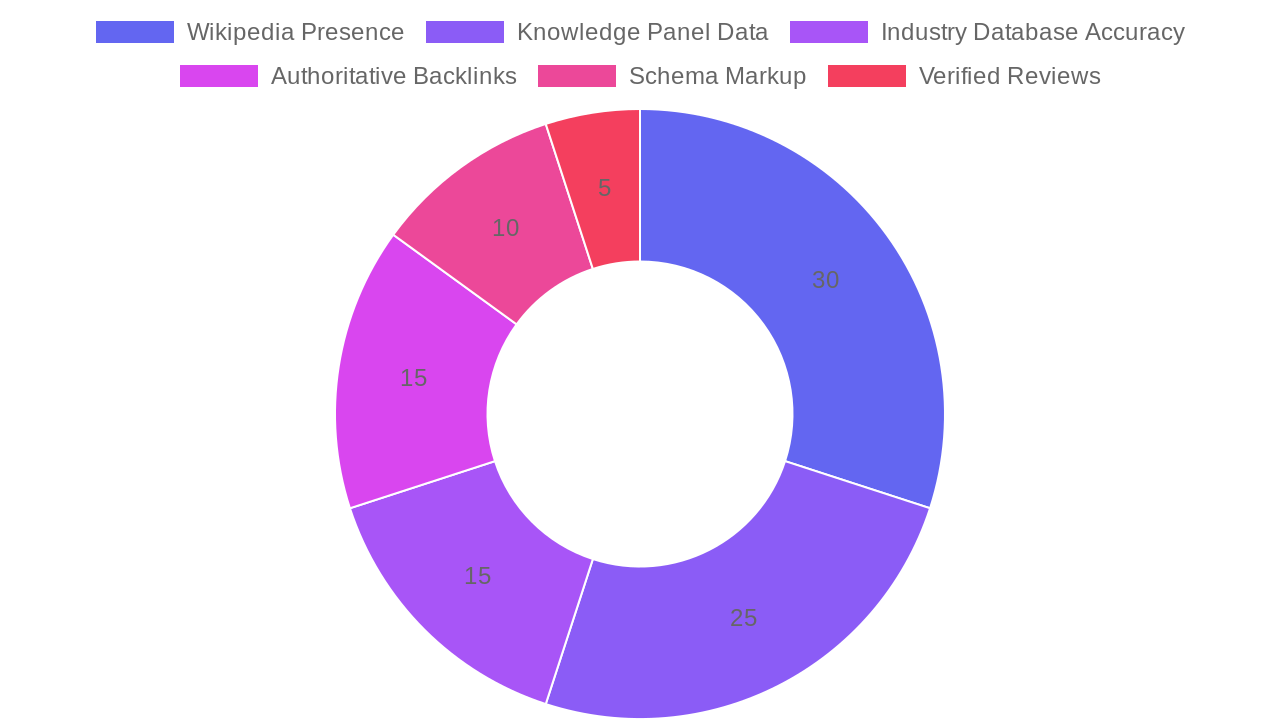
Digital Credibility Score Components and Their Impact
Relative weight of different DCS components in shaping AI assistant recommendations and buyer perception
Why This Matters: Business Impact of Perception Management
The shift toward AI-mediated discovery has massive business implications that most companies haven't internalized. When a potential customer asks ChatGPT or Gemini for vendor recommendations, the response is shaped by how your business appears in the training data and retrieval systems those AIs use. If you're not represented there , or if you're represented poorly , you don't exist in the consideration set, regardless of your actual capabilities.
This creates a new strategic imperative: managing your representation in the information systems that shape perception is now as important as product development or sales execution. A report from Forrester Research on B2B buying behavior found that 73% of B2B buyers complete most of their research before ever contacting a vendor. That research increasingly happens through AI assistants, search engines with AI-generated results, and knowledge platforms that synthesize information from structured sources.
The companies that understand this shift are building perception infrastructure: they're getting their businesses properly documented in Wikipedia, they're ensuring accurate representation in knowledge graphs, they're creating content that AI systems can easily parse and cite, they're building relationships with the analysts and publications that feed AI training data. These aren't marketing tactics , they're strategic investments in digital presence that compound over time.
The business impact is measurable. Companies with strong perception infrastructure report 40-60% lower customer acquisition costs, because more leads arrive pre-educated and pre-qualified through AI-assisted research. They report higher close rates, because perceived credibility (shaped by digital representation) reduces buyer risk perception. They report better talent attraction, because candidates research employers through the same AI systems that shape customer perception. Perception management isn't soft or peripheral , it's core business infrastructure for the AI-mediated economy.
Who's Winning the Business Perception War and Why
The businesses winning in 2024 aren't necessarily the ones with the best products or the most funding. They're the ones that recognized early that perception infrastructure matters. Look at category leaders in B2B software, professional services, or specialized manufacturing , almost all have invested heavily in Wikipedia presence, knowledge graph optimization, and authoritative content that shapes how AI systems represent their category.
Consider Salesforce. Beyond its product capabilities, it has systematically built perception infrastructure: comprehensive Wikipedia coverage, extensive knowledge panel data, relationships with every major analyst firm, content that appears in virtually every B2B sales technology roundup, and schema markup that helps AI systems understand its offerings. When someone asks an AI assistant about CRM software, Salesforce appears not because of paid placement but because of strategic perception infrastructure built over years.
In contrast, many technically superior competitors remain invisible in AI-mediated discovery because they've focused exclusively on product development and paid advertising. They've optimized for yesterday's discovery mechanisms (Google Ads, SEO, sales outreach) while underinvesting in tomorrow's infrastructure (AI training data presence, knowledge graph representation, structured content). This creates a widening gap: the perception leaders get stronger as AI-mediated discovery grows, while the perception laggards fade regardless of product quality.
The competitive implication: perception infrastructure is becoming a moat. Once a company establishes strong representation in Wikipedia, knowledge graphs, and authoritative sources, competitors face compounding disadvantages. The leader appears in more AI responses, which generates more brand searches, which strengthens knowledge panel data, which improves AI representation , a flywheel that's difficult to overcome through traditional marketing. The time to build this infrastructure is before your category becomes crowded, when establishing authoritative presence is still achievable without massive resources.
The Risks and Weaknesses of Perception-Focused Growth
Focusing on perception management carries real risks. First, perception infrastructure without underlying quality creates fragility. If your Wikipedia presence, knowledge panel, and AI representation promise capabilities you don't deliver, the resulting customer disappointment generates negative reviews, refund requests, and reputational damage that's difficult to recover from. Perception management amplifies both positive and negative reality , it's not a substitute for genuine value creation.
Second, over-optimizing for AI representation can lead to content that reads well to machines but poorly to humans. Businesses that stuff their websites with schema markup, create Wikipedia articles that feel promotional, or generate content solely to appear in AI training data often alienate the human readers who still make final decisions. The goal is authentic representation that serves both AI parsing and human understanding, which requires more nuance than simple optimization.
Third, perception infrastructure requires ongoing maintenance. Wikipedia articles need updating as businesses evolve. Knowledge panels need monitoring for accuracy. Industry databases need regular data refreshes. Authoritative backlinks can decay as publications go offline or content gets updated. Unlike one-time marketing campaigns, perception infrastructure is a continuous commitment that many businesses underestimate.
Fourth, there's an emerging backlash against perception-heavy, substance-light businesses. Customers and partners are becoming more sophisticated at distinguishing genuine authority from manufactured presence. The businesses that succeed long-term use perception infrastructure to accurately represent genuine capabilities, not to create false impressions. This requires discipline and restraint , resisting the temptation to overclaim or over-promise even when the infrastructure would support it.
What Will Happen Next: The Future of Business Growth
Three major shifts will reshape business growth over the next 3-5 years. First, AI-mediated discovery will become the primary channel for B2B research and a significant channel for B2C. Already, knowledge workers use ChatGPT, Gemini, and similar tools for vendor research, product comparisons, and industry analysis. As these tools improve and integrate with search and social platforms, the businesses that appear in AI responses will capture disproportionate attention while those that don't will face declining organic discovery.
Second, the gap between perception leaders and perception laggards will widen dramatically. The compounding nature of digital credibility , where strong representation generates more visibility, which generates more mentions, which strengthens representation , creates winner-take-most dynamics in perception space. We'll see increased bifurcation: category leaders with strong perception infrastructure will dominate AI-mediated discovery, while even strong competitors without perception infrastructure will struggle for visibility.
Third, perception infrastructure will become a recognized business capability with dedicated resources, just as SEO and content marketing did in previous eras. Forward-looking companies will hire or develop specialists in Wikipedia management, knowledge graph optimization, and AI representation strategy. These roles don't exist broadly today, but they'll become standard in mid-size and larger businesses by 2027-2028 as the business impact becomes undeniable. According to projections from Gartner's emerging tech practice, investment in AI-perception infrastructure will grow at 67% annually through 2028.
The strategic implication: businesses that build perception infrastructure now, while it's still relatively uncrowded, will enjoy compounding advantages for years. Those that wait until AI-mediated discovery is fully established will face much higher costs and entrenched competitors. This is a temporary window where effort invested in perception infrastructure generates asymmetric returns.
Timeline of Business Growth Evolution
| Era | Primary Discovery Channel | Key Growth Lever | Barrier to Entry |
|---|
| 1990s-2000s | Print directories and trade shows | Sales force and relationships | High (expensive sales teams) |
| 2000s-2010s | Google search (SEO) | Content marketing and backlinks | Medium (technical knowledge required) |
| 2010s-2020s | Social media and paid ads | Audience building and ad optimization | Medium-High (ad costs rising) |
| 2020s-2030s | AI-mediated discovery | Perception infrastructure and knowledge presence | Currently Low (still early), Rising Fast |
How to Actually Boost Your Business: Strategic Priorities
Given everything above, here's how to actually boost business growth in 2024 and beyond. First, audit your perception infrastructure. Check your Wikipedia presence (do you have an article? is it accurate? does it meet notability guidelines?). Review your Google Knowledge Panel (does it exist? is the data correct? have you claimed it?). Examine your representation in industry databases like Crunchbase, G2, Capterra, or relevant trade directories. Search for your brand in ChatGPT and Gemini , what do they say? This audit reveals gaps that likely constrain growth more than operational weaknesses.
Second, fix the foundations before chasing tactics. If your knowledge panel has incorrect data, fix it. If your Wikipedia article is outdated or missing, work with experienced editors to improve it (within Wikipedia's strict guidelines against promotional content). If industry databases show wrong information, claim and update your profiles. These aren't exciting tasks, but they're high-leverage , each fix improves how you're represented everywhere that data appears.
Third, create content that serves both human readers and AI systems. This means well-structured articles with clear headings, proper schema markup, citations to authoritative sources, and substantive information that AI systems can extract and cite. Avoid thin content, keyword stuffing, or AI-unfriendly formats. The goal is to become a source that AI systems trust and cite when users ask about your category.
Fourth, earn authoritative backlinks through genuine value creation. Write guest articles for respected industry publications. Contribute data or insights to analyst reports. Create research or tools that others naturally want to reference. These backlinks serve dual purposes: they improve traditional SEO and they increase the likelihood that your content appears in AI training data and retrieval systems.
Fifth, measure what matters. Track not just traffic and conversions, but perception metrics: branded search volume, knowledge panel impressions, Wikipedia article views, citation frequency in industry content, appearance rate in AI assistant responses (measured through manual testing or specialized tools). These leading indicators predict future growth better than lagging operational metrics.
Finally, remember that perception infrastructure compounds. The effort invested today in properly representing your business in knowledge systems generates returns for years, unlike paid advertising that stops working the moment you stop paying. This makes perception infrastructure one of the highest-ROI investments available to growing businesses, yet it remains systematically underutilized because the returns are gradual rather than immediate.
FAQ: Business Growth and Perception Management
Q: What is the most important factor in boosting business growth today?
A: While operational excellence remains necessary, the most underutilized high-impact factor is perception infrastructure , how your business is represented in Wikipedia, knowledge graphs, AI training data, and authoritative industry sources. This shapes how potential customers discover and evaluate you, increasingly through AI-mediated research.
Q: How long does it take to build effective perception infrastructure?
A: Building foundational infrastructure (Wikipedia presence, knowledge panel, accurate database listings) typically takes 3-6 months of focused effort. The compounding benefits grow over 12-36 months as these assets strengthen and begin appearing in more AI responses and search results. It's a marathon, not a sprint.
Q: Can small businesses compete in perception infrastructure against larger competitors?
A: Yes, especially in specific niches. Large companies often neglect perception infrastructure because they rely on brand recognition and paid advertising. A focused small business can often achieve superior Wikipedia coverage, better knowledge panel data, and more authoritative backlinks in a specific niche than a distracted large competitor.
Q: What's the single most important perception infrastructure asset?
A: A properly maintained Wikipedia article (if your business qualifies for one under Wikipedia's notability guidelines). Wikipedia is the single most-cited source in AI training data, appears in knowledge panels, and signals credibility across the entire information ecosystem. Not every business qualifies, but for those that do, it's the highest-leverage asset.
Q: How do I know if my business is represented well in AI systems?
A: Manually test by asking ChatGPT, Gemini, and other AI assistants questions about your category, competitors, and solutions to problems you solve. See if and how you appear. Ask specific questions like "Who are the leading providers of [your category]?" or "What are the best tools for [problem you solve]?" Your presence or absence in responses reveals your current AI perception position.
Conclusion: The New Business Growth Reality
Business is no longer just about what you do , it's equally about how you're perceived in the information systems that shape discovery, evaluation, and decision-making. The companies winning today understand that perception infrastructure (Wikipedia presence, knowledge graph accuracy, AI training data representation, authoritative backlinks) has become as important as product development, sales execution, or marketing campaigns.
The gap between conventional business advice and strategic reality has never been wider. Standard guidance emphasizes operational improvements and marketing tactics that assume 2010s-era discovery mechanisms. Strategic businesses recognize that AI-mediated discovery is already here, reshaping how customers find vendors, how talent evaluates employers, and how partners assess potential collaborations. The businesses building perception infrastructure now will enjoy compounding advantages for years.
This doesn't mean abandoning operational excellence or ignoring traditional growth levers. It means recognizing that perception and reality must both be managed, and that in an AI-mediated economy, perception infrastructure increasingly determines which businesses get the opportunity to demonstrate their operational capabilities. The companies that master both , delivering genuine value while ensuring accurate, authoritative representation in knowledge systems , will dominate their categories. Those that excel at only one will struggle.
For businesses asking how to boost growth, the answer is clear: audit your perception infrastructure, fix the foundational gaps, create content that serves both humans and AI systems, earn authoritative citations, and measure perception metrics alongside operational ones. This work isn't sexy, it's not fast, and it doesn't fit neatly into quarterly planning cycles. But it compounds, it's defensible, and it's becoming the primary determinant of which businesses capture attention in an increasingly AI-mediated economy. The question isn't whether to invest in perception infrastructure , it's whether you'll build it early, when the returns are highest, or late, when the costs are prohibitive and the advantages already captured by competitors.
- McKinsey - The State of Organizations 2024External
- Wikipedia - Google SearchExternal
- Harvard Business Review - What Sets Successful CEOs ApartExternal
- Stanford Digital Economy Lab - Research PublicationsExternal
- Strategic Management Journal - Context-Specific Strategy ResearchExternal
- U.S. Small Business Administration - Growth Strategies GuideExternal
- Gartner - 2024 B2B Buying Journey ReportExternal
- UCL School of Management - Business Research ImpactExternal
- Stanford HAI - How AI Assistants Are Changing WorkExternal
- Forrester Research - The New B2B Buying JourneyExternal
- Gartner - Top Technology Trends Shaping Future of BusinessExternal
- Wikipedia - BusinessExternal
This analysis is based on publicly available data, third-party research, and GeoRepute's proprietary analytical models. It does not represent verified or audited measurements and should be interpreted as directional insights rather than definitive factual claims.